



By Ray Marden, CBET, CHTM
There are as many reasons to choose a career, as there are many careers to choose from. Most people consider much more than just the salary when choosing a particular career path. So, what considerations would lead someone to choose to become a healthcare technology management (HTM) professional?
One of the top reasons cited for career choice is challenge and excitement.
Most folks want a reason to get out of bed in the morning, and biomed offers continuous challenge and excitement. Each day is spent supporting the operational infrastructure of patient care by working with technology and other caregivers in various clinical settings. Many biomeds report a feeling of a tremendous sense of pride and accomplishment each day just knowing that their work has a direct impact on patient safety. Ever wonder who the O.R. staff would call if a device fails during surgery? It could be you!
Does physiology and technology truly interest you? I always say that my favorite biomed techs are people who have a passion for applied physics. Folks who really “nerd” out on the tech and physiology make the happiest bmets, and in HTM, you get to put your hands on some of the coolest technology in the world. You’ll also find yourself behind the scenes in every health care setting from the morgue to the MRI suite. If words like venturi, stator or peristaltic get your juices flowing, HTM will not disappoint.
Another reason people choose one career over another is the opportunity for growth.
HTM is a unique field in that it was staffed fully with very little growth or turnover for decades. Meaning that it wasn’t uncommon for techs who graduated tech school in the mid 1980’s to keep the same job in the same hospital for 30 plus years. But as the boomer generation has aged, health care has boomed, and the amount of technology used in patient care has expanded exponentially. Now many of those seasoned technicians have retired or are retiring soon. This creates two issues. First, their senior positions will have to be filled. Second, there was never really a workforce behind them ready to step into their shoes. The ones that were have already stepped up. This leaves a big hole in the middle of this workforce. Do a job search, and you’ll find a tremendous need for mid-level BMETs. What does this mean for someone just starting out? It means there’s a fast-track for growth! An entry level technician can only be responsible for so much, so it’s in everyone’s best interest to promote training and growth. The time has never been better to get started in this field.
Almost no one chooses a career path without at least considering salary.
HTM offers a fairly wide range of pay scales depending on your region. In my opinion, many states don’t pay entry level techs enough, but the average salary nationwide for a BMET I is around $48k per year. Most of those jobs include competitive benefits packages, which is not bad for a job that doesn’t require a four-year degree. The good news is that many techs move up pretty quickly due to the issues discussed above, and a BMET II can expect to make around $60k. It is easy to demonstrate your value by getting training and taking on increased responsibilities, such as taking an on-call rotation or taking the lead on a specific department or modality.
Another top reason people list for career choice is the work environment.
I came from working in the construction trades up in Alaska prior to HTM. I chose biomed largely because it was indoors! I found the year-round, consistent indoor work to be a major plus. I’ve known many good BMETs who were tradespersons before their start in HTM. Skills learned on job sites will transfer to the clinical setting more than you might guess. I thought when I started out that I’d just be in the shop troubleshooting equipment. It never occurred to me that I’d be involved in major projects and installations or sitting in on surgeries. Some techs sit at their bench and crank out inspections on fleets of small devices, and some pull high tension cables through 4” conduit installing x-ray equipment. Some are putting IT skills to use as device network specialists. The work environment is so diverse that there is something for everyone.
Finally, most biomed shops offer a sense of camaraderie. BMETs tend to be helpful, service-minded individuals, and while the vibe varies from shop to shop, I find that all are pretty accepting and warm.
Excitement, challenge, competitive pay, cool technology, lots of opportunities for growth and specialization, minimal education requirements, diverse clinical settings, making a huge impact on health care – if these are priorities to you, welcome to HTM!

What is ‘company culture’ really about?
I’ve been hearing about “company culture” quite a bit these days, and about how important it is, especially within today’s challenging work environment.

How to Approach Political Conversations at Work
Political conversation is fraught with potential conflict. Guidelines and “safe words” are two things experts say can tame political discourse.

Seasoned Pros Navigate Challenge of Younger Bosses
How can people leverage their years of experience without offending their much-younger supervisor?

A BMET’s Quest for Quality from HTM Front Lines
How does a single technician help foster a culture of quality without pointing fingers or making unpleasant waves?

How to Respond to Rejection After a Good Job Interview
You have finished a job interview, feel you’ve done well and are anxiously awaiting an offer. And then you get the call/email/text/letter saying you haven’t been hired.

Should Grads Accept First Job Offer?
The question many students have: Should I take the first job offer that comes along – even if it isn’t exactly what I’m looking for? Here, career experts weigh in with their advice.

Should You Still Apply if You Don’t Meet All the Qualifications?
How important is the list of preferred qualifications most job listings include? If someone is lacking one or two of those qualifications, is it a waste of time to apply?

Personal Improvement Project: Soft-Skill Development
Industry experts agree, soft skills are key!
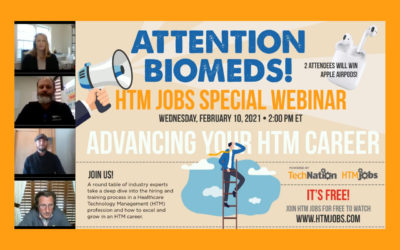
Webinar: Advancing Your HTM Career
Learn about the hiring and training process in a Healthcare Technology Management (HTM) profession and how to excel and grow in an HTM career.

Imposter Syndrome Antidotes
Un-checked feelings of unworthiness and thoughts of doubt can grow into what is commonly known as imposter syndrome.
